The Papst family: inventive spirit from St. Georgen
Hermann Papst (1902–1981) is one of the most versatile German inventors of the 20th century.
From his „Denkwerkstatt“ in St. Georgen in the Black Forest came around 1,000 technical concepts; more than 200 German and some 400 foreign patents bear his name. His Papst motor laid the foundation for Papst Motoren KG, whose St. Georgen plant today belongs to ebm-papst.
The Papst family of entrepreneurs converted the former Tobias Baeuerle clock factory into Hotel FederWERK.

Hermann Papst at a glance
| Dates | b. 13 August 1902, d. 6 May 1981 |
| Education | College of Electrical Engineering at the Technologisches Gewerbemuseum (TGM) in Vienna, 1916–1921 |
| In St. Georgen | From 1928 |
| Best-known invention | The Papst motor, core patent 1932 |
| Companies | Engineering office (1937), Papst Motoren KG (1950) |
| Honour | Cross of Merit on Ribbon of the Federal Republic of Germany (1979) |
| At FederWERK | 9 rooms tell of Hermann Papst, 2 of Georg F. Papst, 2 of ebm-papst |
Who was Hermann Papst?
Hermann Papst was a tinkerer, a design engineer and an entrepreneur all in one. From 1916 to 1921 he attended the College of Electrical Engineering at the Technologisches Gewerbemuseum (TGM) in Vienna. He filed his first patent in 1919 – at the age of 17, for the design of an electric pendulum clock. A fitting start for someone who would later write industrial history in the clockmaking town of St. Georgen.
In the 1920s Papst worked in Vienna and Berlin as a designer and inventor for various companies. He worked on electric motors, automobiles, carburettors and suspension systems for two-wheelers, and worked freelance for the London company Dual Motors. His biographer Friedemann Maurer has documented around 1,000 innovative technical concepts from Papst’s „Denkwerkstatt“ (Hermann Papst – Leben und Werk eines Erfinders, 2002).

This image was created using AI.
1928: arrival in St. Georgen and the DUAL motor
Hermann Papst came to St. Georgen in 1928. Here he worked with the Steidinger brothers, a family of inventive Black Forest clockmakers who had been building drives for gramophones since 1907. Together they brought to market a drive that united two worlds: a spring mechanism with a hand wind and an electric motor. The DUAL motor ran on spring power and on electricity – designed by Hermann Papst, produced by the Steidinger brothers.
The idea of the dual drive later gave one of the best-known brands in phono history its name: from 1935 all products made by the Steidinger brothers bore the name DUAL. You can discover the 1928 DUAL motor in room 123 today.
Papst and Steidinger: two families, one town’s history
In 1931 Hermann Papst married Mathilde Steidinger; the marriage produced five children. This joined two families that shaped St. Georgen for decades: the Steidingers, whose ancestors made clock parts in the „Grumpenloch“ in the Stockwald and from whose workshops DUAL and Perpetuum-Ebner emerged – and the Vienna-trained electrical engineer who brought the clockmakers’ mechanics together with electric drives.

The Papst motor: an idea that travelled the world
In 1932 Hermann Papst was granted the core patent for a rotating-field motor with an external cage – the basis of the later world-famous Papst motor. In the external-rotor principle the rotor turns on the outside around the stationary part of the motor. This allows particularly compact, smooth-running drives, for example for fans and blowers.
In 1937 Papst founded an engineering office for new designs in St. Georgen. In 1948 he started his own production – in the buildings of the former Philipp Haas & Söhne clock factory. In 1950 this became Papst Motoren KG, which moved into large-scale production of electric motors; in 1957 he expanded production in Herbolzheim to complete motors. Early on, Papst Motoren integrated the control electronics directly into the hub of brushless DC motors – a principle you can discover in room 014.
An inventor without limits
Hermann Papst’s creativity did not stop at the electric motor. In a research department of his own at Papst Motoren he developed ideas that still astonish today:
- the swashplate motor, a two-stroke opposed-piston combustion engine with two angled plates on a common shaft – the basic idea dating from 1942, particularly suited to aircraft and ship propeller drives (rooms 016 and 115)
- the Telerapid, a mechanical speed dial for 50 fixed telephone numbers from the 1930s (room 321)
- the external-cage squirrel-cage rotor with skewed cast-aluminium rotor bars, the basic idea dating from 1955 (room 112)
- a motor with a tape-tensioning lever for tape recorders (room 122), a three-blade compact fan (room 231) and the Multidrive cassette mechanism for hi-fi recorders (room 331)
In 1979 Hermann Papst received the Cross of Merit on Ribbon of the Federal Republic of Germany. He died on 6 May 1981.
Georg F. Papst: patents, the Phono Museum and vision
Georg F. Papst (1935–2012), son of Hermann Papst, carried on the legacy in his own way. After the family company Papst Motoren was sold in 1992, he took over its historic patent portfolio and founded PAPST LICENSING. The company, based in St. Georgen since 2002, helps businesses and individual inventors enforce their patent rights. Rooms 216 (hard disk) and 320 (24-coil stepper motor) lead into this digital chapter.
Particularly important for the town: in 2010 Georg Papst provided the impetus, with both planning and financial commitment, for the redesign of the German Phono Museum. Since then the museum has shown the development of sound recording and music reproduction almost without a gap – a few steps from FederWERK.
The Papst family and Hotel FederWERK
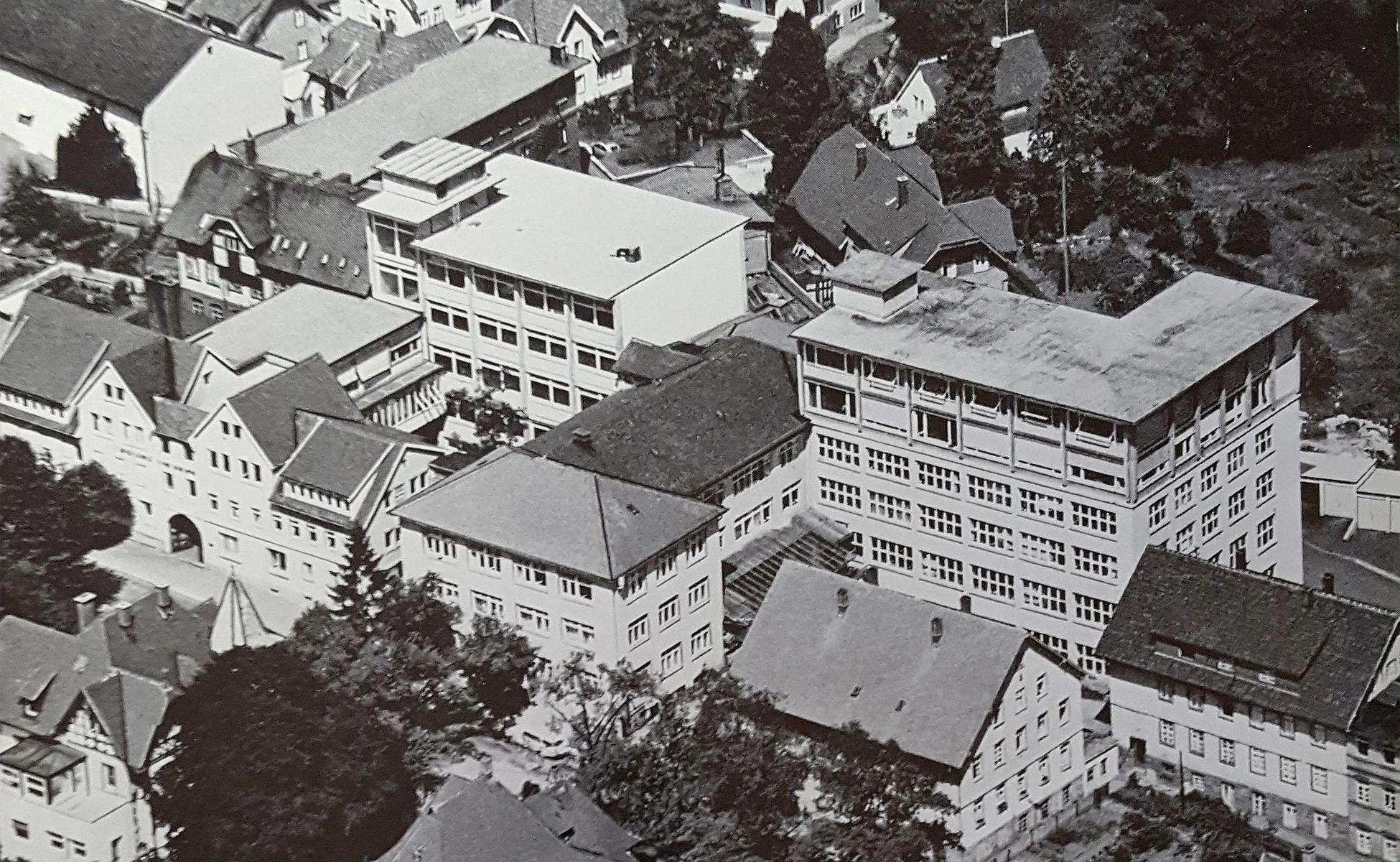
The Papst family of entrepreneurs from St. Georgen acquired the site of the former Tobias Baeuerle & Söhne clock factory and had it converted into Hotel FederWERK from 2016. The hotel opened in 2018. With that, a circle closes: just as Hermann Papst made a new start in a former clock factory in 1948, his family has once again given an old factory building a future.
At FederWERK, Hermann Papst is the guiding figure of the house. His ideas join together what the hotel joins together too: mechanics and electrics, craft and industry, origin and future.

These rooms tell of the Papst family
Rooms at Hotel FederWERK dedicated to Hermann Papst, Georg F. Papst and ebm-papst
Experience Hermann Papst in St. Georgen
Since 2002 an exhibition in the Haus Mühlegg in St. Georgen has commemorated the life’s work of the inventor and entrepreneur – the Hermann Papst Museum. Tours are free of charge and available in German and English, by prior appointment through PAPST LICENSING.
Room stories
51 rooms, 51 stories: from a wooden-geared clock made in 1730 to XR learning software. Find out who your room is dedicated to.