At FederWERK there are no invented themes.
At Hotel FederWERK in St. Georgen, each of the 51 rooms is dedicated to a real person, a company or a product that shaped the industrial and innovation history of the Black Forest. A large-format wall motif and the accompanying story make every room a chapter of its own – from a wooden-geared clock made in 1730 to today’s XR learning software.
The rooms tell of real people, companies and products from St. Georgen and the region: of clockmakers and tinkerers, of factory founders and families of inventors, of clock movements, gramophones, motors and machines.
The rooms are deliberately different, because the paths they tell of were never uniform either. Technology is not explained here; it works through design, objects and atmosphere. You do not need to know anything in order to sleep well. But you may well become curious.
By the way: the room categories recall the factory too. They are named after the stages of a company’s work – Development, Production and Sales.
How to discover your room story
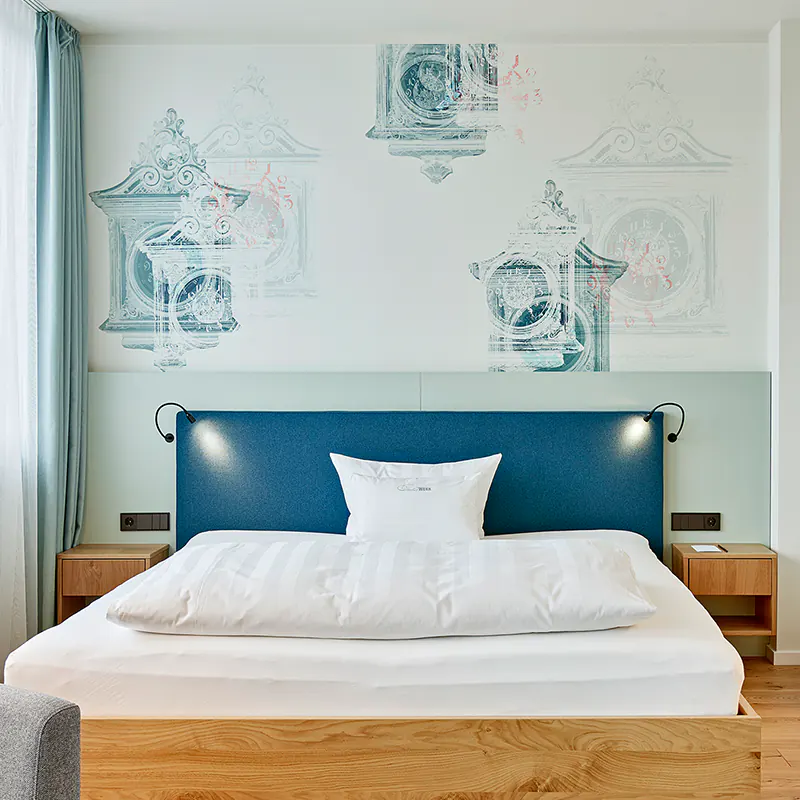
Oh the walls:
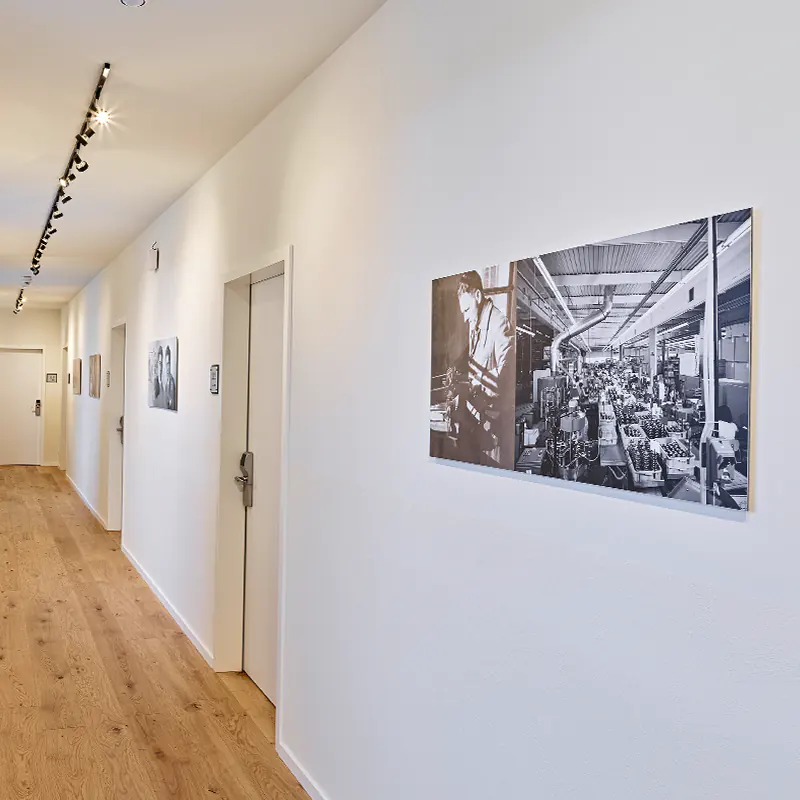
A large-format image depicts the focal point of your room—a clock, an engine, a machine, or a musical instrument.
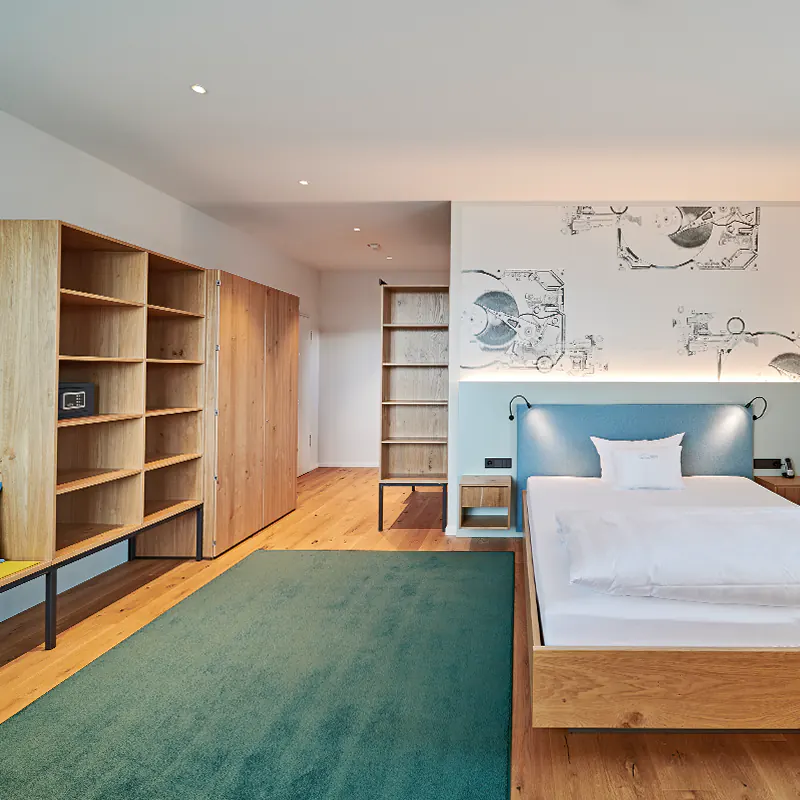
Im the rooms:
The history of the individual or company, including biographical details, a chronology, and key features, for reference.
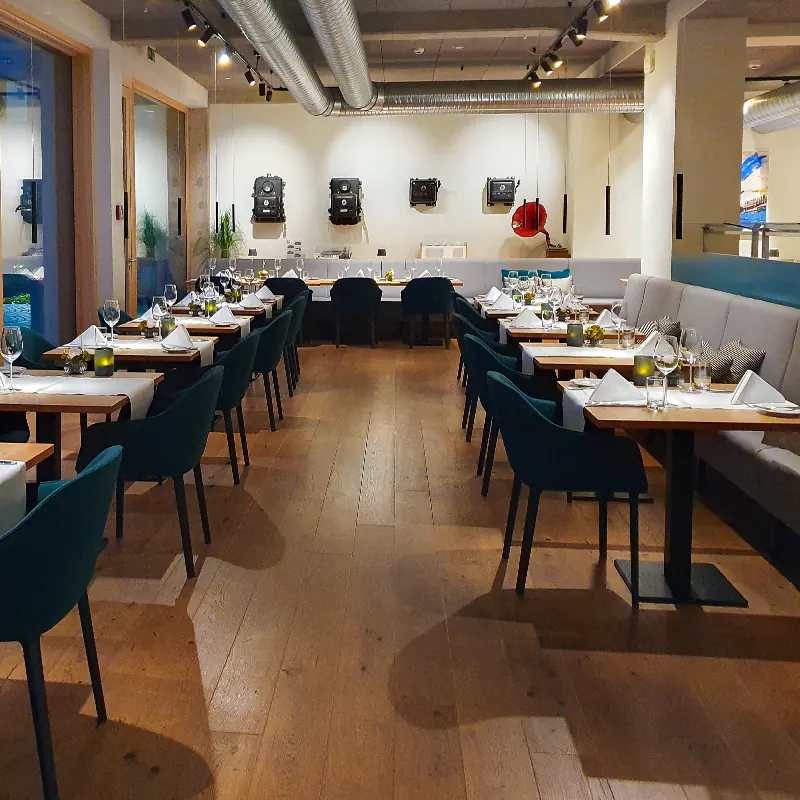
In the Restaurant FeinWERK:
Place cards also tell the stories of the rooms at the table.
In the entire House:
Hallways and stairwells showcase further chapters in St. Georgen's industrial history.
The eight themed worlds of the rooms
The origin of time
– Black Forest clocks & craft
The beginnings: wooden-geared clocks, clock dials and hands, clock traders and the first factories.
Rooms
110 | 220 | 221 | 323 | 324
Mechanics & precision
– precision engineering
Calculating machines, meters, an astronomical art clock and clamping technology accurate to a few thousandths of a millimetre.
Rooms
111 | 116 | 120 | 212 | 214 | 225 | 333
Sound & tone
– the phono industry
Phonograph, gramophone, record changer and turntables by DUAL and Perpetuum-Ebner.
Rooms
015 | 114 | 131 | 211 | 322 | 325 | 330 | 331
Drive & motion
– motors & energy
From the DUAL motor and the Papst motor to modern drives by ebm-papst.
Rooms
014 | 016 | 112 | 115 | 122 | 123 | 127 | 231
Machines & production
– industry as the foundation
Lathes, milling machines, automatic lathes and gripping systems: the tools of industry.
Rooms
133 | 210 | 215 | 230 | 232 | 316 | 332
Everyday technology & series production
Alarm clocks, time switches, ballpoint pens and toy motors – technology almost everyone knows.
Rooms
012 | 124 | 125 | 130 | 132 | 222 | 224 | 227 | 321 | 327
Protection, health & responsibility
Precision in the service of people: an anaesthesia stopwatch, radar sensor mountings and breathing aids.
Rooms
121 | 223 | 233
Digitalisation & the future
Hard disk, stepper motor and virtual learning – looking ahead.
Rooms
216 | 320 | 416
How to discover your room story
Room 323
The wooden-geared clock from the early days
Andreas Müller (1684–1745) is considered the first clockmaker in St. Georgen. According to the 1859 chronicle by the pastor Eduard Christian Martini, he taught himself the craft „simply by watching and imitating“. His original wooden-geared clock of 1730 has wheels and shafts made of wood, a verge escapement with a balance beam and an alarm mechanism striking a glass bell.
Room 330
Serial number 1
In 1907 the brothers Christian and Josef Steidinger began manufacturing together. The gramophone drive with serial number 1 dates from that year: spring drive, hand winding by crank and a centrifugal governor for 78 revolutions per minute. A year later the drives caused a stir at the Leipzig spring fair – the beginning of a story that led to DUAL.
Room 125
The clock for carrier pigeons
A clock that measures flight times: the pigeon timing clock by Tobias Baeuerle & Söhne was started at the moment of release. At the destination the arrival times were stopped, the pigeons’ rings were locked into a rotating magazine and the time was printed on a paper strip. It was built in the company in whose factory building you are staying today.
Room 121
The anaesthesia stopwatch
Otto Rapp, who began his clockmaking apprenticeship at Tobias Baeuerle in 1912, designed an anaesthesia monitoring clock for the Dräger works in Lübeck in 1952. The anaesthetist counted 15 pulse beats or five breaths and read off pulse and respiration on the scale. Around 40,000 units were made over more than 40 years, with dials in nine languages.
Room 121
The anaesthesia stopwatch
Room 327 – The world’s first quartz alarm clock
In 1971 Staiger presented the CHROMETRON QUARTZ in St. Georgen – the world’s first battery-powered quartz alarm clock. A 1.5-volt battery and a quartz crystal running at 16.384 kilohertz provided precise one-second steps.
The anaesthesia stopwatch
Room 416 – Looking ahead
The line of innovation does not end in the past. In 2004 Martin Zimmermann founded the first virtual reality cluster in the Black Forest in St. Georgen; his company imsimity develops the XR learning software CyberClassroom, which makes the invisible visible and tangible in the classroom. Anyone staying here wakes up in the future.
The origin of time: Black Forest clocks & craft
c. 1680–1850 · craft, regionality, origin
At the beginning there are clockmakers in the side valleys of St. Georgen: farmers, craftsmen and traders who built the first Black Forest clocks out of wood, brass and a great deal of patience.
Andreas Müller (1684–1745)
Andreas Müller is considered the first clockmaker in St. Georgen. The pastor and chronicler Eduard Christian Martini wrote in 1859 that he had „probably acquired the craft simply by watching and imitating“. In the „Nest“, a small house in Brigach, he ran a workshop with his son and son-in-law. In 1725, together with Jerg Weißer, he repaired the tower clock of the Lorenzkirche, for 12 guilders plus food and drink.
- Room 323 – the original wooden-geared clock of 1730: a clock from the early days of Black Forest clockmaking. The wheels and shafts are made of wood, with a verge escapement with balance beam and an alarm mechanism striking a glass bell.
Philipp Haas (1802–1874)
Philipp Haas grew up in a family of clockmakers in the Stockwald, worked as a shepherd boy as a child and took over the clock trade in Bavarian Franconia at the age of 17. In 1831 he founded a clock trading company at the Gasthaus Hirsch. His sons turned it into Philipp Haas & Söhne, which from 1867 built metal clock movements on the „American principle“ – by their own account the first in Baden to do so. Around 1913 some 350 people worked there. In 1948 Hermann Papst moved into the company’s former buildings with his Papst motors.
- Room 110 – Black Forest clock of 1885: a wooden movement in „Schotten“ size with brass wheels, iron shafts and a quarter-hour striking mechanism.
Andreas Maier (1828–1900)
Andreas Maier, the son of poor parents, learned the painting of wooden clock dials and in 1852 founded the only factory of its kind in the Black Forest in St. Georgen. It worked with lithography. His descendants turned it into an internationally known maker of clock hands with the motto „Our hands, please note, are our strength“. It survives today as A. Maier Präzision.
- Room 220 – Black Forest clock of 1890: a nursery clock with a carved and painted dial. The cast weights are shaped like gnomes.
Mathias Bäuerle (1839–1916)
Mathias Bäuerle grew up in a clockmaking family in the Stockwald and founded his own clockmaking business in 1863. At first he made Schotten clocks with spring drives, later regulators. In 1888 he built a factory in St. Georgen and made a name for himself with precise movements and complex striking mechanisms. His brother Tobias founded the company in whose building FederWERK stands today.
- Room 221 – living-room clock of 1895: a fine wall clock for the Austro-Hungarian market, with a hardwood case, spring drive and a striking mechanism on a gong spring.
- Room 332 – the folding machine: after clocks and calculating machines, the company concentrated on folding machines from 1963. It still builds paper-processing machines today.
Mechanics & precision: precision engineering
c. 1850–today · accuracy, engineering thinking
Clockmaking becomes precision engineering. Counting, measuring, switching, clamping: anyone who can measure time can also control machines.
Tobias Baeuerle (1841–1914)
Tobias Baeuerle opened his own clockmaking workshop in Brigach in 1864 and in 1875 built a large factory and residential building on Bahnhofstraße in St. Georgen. From 1888 he made precise regulator pendulum clocks with cases from his own joinery. In 1903 his sons became partners and the company was renamed Tobias Baeuerle & Söhne. In 1964 it celebrated its centenary with 650 employees; its history ended in 1994. Hotel FederWERK now occupies its former factory building.
- Room 125 – clocks and technical movements: what made Tobias Baeuerle & Söhne great.
- Room 214 – meter for liquids: a measuring gear calibrated in „imperial gallons“, probably from the 1920s. It was presumably intended for fuel pumps or water meters and has an enamel dial.
- Room 225 – printing mechanism for recording devices: precision engineering for instruments that record measurements.
- Room 324 – high-precision signal clock: a clock with a signal generator for beacons on moored lightships near the coast, built for Pintsch Bamag in Berlin.
Tobias Bäuerle, son of Mathias (1869–1933)
To become less dependent on the fiercely competitive clockmaking trade, in 1903 Tobias Bäuerle began building mechanical calculating machines under the PEERLESS brand. In 1905 they were awarded a gold medal at the World Exhibition in Liège. Around 1904 the company was also making some 6,000 clocks a month.
- Room 116 – mechanical calculating machine, from 1913: a machine with a stepped drum and hand crank for all four basic arithmetic operations.
Christoph Jäckle (1894–1982)
Christoph Jäckle was the classic Black Forest tinkerer. He trained at Philipp Haas & Söhne and worked for more than four decades as a design engineer at Tobias Baeuerle on technical movements and measuring instruments. He also sat on the town council and led the Protestant brass ensemble in St. Georgen for decades.
- Room 120 – astronomical art clock of 1971: he put eight years and more than 5,000 working hours into this calendar clock. It shows sidereal time, moon phases, sunrise and moonrise and calculates the coming date of Easter every New Year’s Eve. He turned down offers: the clock was not for sale.
Dieter Grässlin (1926–1976)
Dieter Grässlin learned the clockmaking trade at Tobias Baeuerle, studied at the clockmaking school in Furtwangen and founded his own company in 1956. His time switches were patented worldwide.
- Room 012 – mechanical time switch of 1963: the world’s first time switch in the standard 72 × 72 mm housing size, modular in design for electrical installations and heating control.
- Room 222 – electronic digital time switch of 1980: the first of its kind with 127 switching commands.
Johann Friedrich Schlenker (1901–1958)
Johann Friedrich Schlenker started out with a wood-turning workshop. His son and grandson turned it into a precision engineering business in Peterzell, now in its fourth generation.
- Room 212 – hydraulic clamping mandrel: a thin steel membrane expands under pressure and holds the workpiece, with a concentricity accuracy of under 0.005 millimetres.
Peter Sterman (b. 1959)
Peter Sterman started out in 2000 with a design office in the family cellar. In 2002 the company moved with eight employees into the renovated design offices of the old Baeuerle building – that is, into exactly the building in which you are staying today. Today it is a technology leader in bespoke clamping systems.
- Room 111 – clamping system for an eight-speed gearbox: it clamps a gearbox shift wheel firmly and still leaves the bore free of distortion. The tolerance is under 0.004 millimetres.
Ewald Granacher (1923–2016)
Ewald Granacher founded his precision engineering company in St. Georgen in 1968. Today it supplies highly complex parts for aerospace, motorsport and medical technology.
- Room 333 – clamping ring: a component made of bronze alloy with a fine thread, produced in very small batches to strict standards.
Friedrich Schunk (1912–1998)
Friedrich Schunk founded a mechanical workshop in a garage in Lauffen am Neckar in 1945. Under his son Heinz-Dieter it became a world market leader in clamping technology and gripping systems.
- Room 210 – PGN-plus parallel gripper: since 2000 a dependable gripper for almost all handling tasks in production.
Sound & tone: the phono industry
c. 1900–1980 · emotion, culture, innovation
With the gramophone and the record player, technology became emotional. St. Georgen produced drives and turntables that reached millions of people.
Christian (1873–1937) and Josef Steidinger (1876–1925)
The Steidingers were clockmakers in the „Grumpenloch“, a side valley of the Stockwald. In 1907 the brothers founded Gebrüder Steidinger, and in 1908 they showed their gramophone drives at the Leipzig fair. In 1911 Josef set up on his own with Perpetuum, later Perpetuum-Ebner (PE). From 1935 all products made by the Steidinger brothers carried the name DUAL. By 1975 DUAL employed more than 3,500 people in eleven plants.
- Room 330 – gramophone drive of 1907: the drive with serial number 1, with spring drive, crank winding and centrifugal governor for 78 revolutions per minute.
- Room 211 – PE record changer PW 10, from 1949: it played shellac records one after another automatically at the touch of a button.
- Room 325 – DUAL turntable of 1988: a luxury model with a gold-plated platter and tonearm, based on the CS 5000.
DUAL motor: Gebrüder Steidinger and Hermann Papst
In 1927 the Steidinger brothers presented the DUAL motor, a gramophone drive combining a spring mechanism and an electric motor, designed by Hermann Papst. Four years later Papst married Mathilde Steidinger.
- Room 123 – the DUAL motor: an invention that connects two families and two industries.
Siegfried Steidinger (1907–1981)
Christian’s son Siegfried led DUAL through the war and post-war years. The first DUAL record changer appeared in 1949.
- Room 131 – DUAL torch of 1945: a dynamo torch with a squeeze lever, no battery needed. In the first post-war years it was a sought-after item for barter.
German Phono Museum
In 1972 two collectors from St. Georgen laid the foundation for the museum: Gottlob Weißer of PE and Walter Grieshaber of DUAL. In 2010 it was extended and redesigned with support from Georg Papst. Today it shows the development of sound recording almost without a gap, and it is only a few steps from the hotel.
- Rooms 114 and 322 – phonographs and gramophones: among them an Edison phonograph of 1901 and the horn gramophone „Mammut“ of 1916 with a coin slot for use in inns.
Drive & motion: motors and energy
c. 1920–today · progress, efficiency, dynamism
The guiding figure of the house: no name appears at FederWERK as often as Papst.
Hermann Papst (1902–1981)
Hermann Papst is considered one of the most universally gifted German inventors of the 20th century: around 1,000 technical concepts, more than 200 German and some 400 foreign patents. He came to St. Georgen in 1928. In 1932 he patented the rotating-field motor with an external cage, the basis of the world-famous „Papst motor“. His engineering office became Papst Motoren KG in 1950. In 1979 he received the Federal Cross of Merit.
- Room 014 – fan electronics: Papst integrated the control electronics directly into the hub of brushless DC motors early on, for fans with variable speed control.
- Room 112 – external-cage squirrel-cage rotor: developed in his own research department; the basic idea dates from 1955.
- Room 122 – external-cage induction motor with tape-tensioning lever.
- Room 231 – three-blade compact fan: three blades and three strongly curved spokes. The curve prevents all the blades from passing the spokes at the same moment, which makes the fan quieter.
- Room 321 – Telerapid: a development whose basic idea goes back to the 1930s.
- Room 331 – Multidrive cassette mechanism: motors and control magnets sit in one compact drive block, with no gears to wear out, for hi-fi recorders.
Georg F. Papst (1935–2012)
After Papst Motoren was sold, Georg F. Papst founded PAPST LICENSING in 1992 and took over the historic patent portfolio. Licence partners included major manufacturers of hard disks and digital cameras. In 2002 the company moved to St. Georgen.
- Room 216 – hard disk: a magnetic storage drive. The platters spin in a dust-free clean room, driven by a brushless DC motor.
- Room 320 – 24-coil stepper motor: a synchronous motor that turns step by step with a controlled magnetic field.
Gerhard Sturm / ebm-papst
Gerhard Sturm (b. 1934) founded ebm with Heinz Ziehl in 1963. In 1992 it took over Papst Motoren in St. Georgen, and since 2003 the site has been called ebm-papst St. Georgen. With „GreenTech“ ebm-papst focuses on energy efficiency and sustainability and won the German Sustainability Award in 2013.
- Room 127 – ECI motor: a small electric motor that maintains oil pressure in automatic transmissions, in start-stop, hybrid or coasting operation.
Machines & production: industry as the foundation
c. 1850–today · stability, capability
Without machine tools there are no clocks and no motors. These companies built the machines with which the Black Forest produced.
Johann Georg Weisser (1840–1886)
Johann Georg Weisser built small lathes in his father’s forge and in 1856 founded the J. G. Weisser Söhne machine factory in St. Georgen, initially for the clock industry. By the end of the 1950s 420 people worked there. For its 160th anniversary in 2016 the company was given a new address: Johann-Georg-Weisser-Straße 1.
- Rooms 133 and 215 – universal milling machine type FPU, around 1920: with belt drive and universal dividing head.
- Room 232 – precision leadscrew lathe type BEN of 1923: with an individual drive motor and change gearbox.
- Room 316 – twin-spindle automatic lathe Minifront 16D of 1963: with a cam-controlled cross-slide unit.
The Heinemann brothers
Master locksmith Johann Michael Heinemann set up on his own in 1836. His sons founded Gebr. Heinemann and made machines and tools for clockmakers, later lathes that gained a worldwide reputation. His daughter Anna Maria married Tobias Baeuerle in 1868.
- Room 230 – clockmaker’s lathe, around 1880: with a wooden frame and treadle drive, signed „HEINEMANN“.
Everyday technology & series production
c. 1950–2000 · usefulness, readiness for series production
People held many things from St. Georgen in their hands every day, often without knowing it.
Hermann (1902–1964) and Wilhelm Schmidt (1890–1966)
The brothers founded a supplier business for the clock industry in 1938. After a fire they started again in 1948, with ballpoint pen refills. Schmidt Technology grew out of that.
- Rooms 132 and 227 – ballpoint pens of the 1950s: with a Schmidt push mechanism and a standardised Schmidt refill.
Johann (1871–1941) and Reinhold Obergfell
Johann Obergfell founded his own factory for clock parts in 1899. Together with the designer Johann Georg Kieninger, KUNDO (Kieninger und Obergfell) was created in 1918. In 1986 KUNDO was the first manufacturer in the world to present a radio-controlled table clock.
- Room 124 – synchronous alarm clock of 1975: an alarm clock with a synchronous motor and a display using printed bands for hours, minutes and seconds.
The Staiger brothers and Werner Staiger (1909–1977)
A tinsmith’s business founded in 1830 became the Gebr. Staiger apparatus works. After 1945 it made toys with the permission of the occupying authorities, later clocks. Werner Staiger ran the company from 1937.
- Room 130 – MIGNON toy spring motor of 1945: metal construction kits and model railways were among the first toys after the war. The motor has a start-stop switch and can run forwards and backwards.
- Room 327 – Staiger CHROMETRON QUARTZ of 1971: the world’s first battery-powered quartz alarm clock.
Horst Häseler (1928–2014)
In 1983 Horst Häseler founded Häseler Metalltechnik (HMT) with Pia Neininger out of parts of the insolvent DUAL group. Today it is a specialist in stamping technology and technical cleanliness for the automotive industry.
- Room 223 – mounting for a radar sensor, 2008: made for Mazda vehicles for the US market.
- Room 224 – side panel for an internet radio, 2001: a car radio for FIAT.
Protection, health & responsibility
c. 1950–today · safety, humanity
Precision that protects people: from the clock at the operating table to the blower that helps with breathing.
Otto Rapp (1897–1978)
Otto Rapp trained at Tobias Baeuerle. After the war he had to found his own company in 1949. Among other things he designed the cab clock for the V 200 diesel locomotives on the Schwarzwaldbahn.
- Room 121 – anaesthesia stopwatch: built for the Dräger works in Lübeck, with dials in nine languages, around 40,000 units in 40 years. The anaesthetist counted 15 pulse beats or 5 breaths, stopped the time and read off pulse or respiration directly.
ebm-papst: the quiet breathing aid
- Room 233 – quiet breathing aid: a radial blower for CPAP and ventilation devices that supports breathing with a regulated supply of fresh air.
Digitalisation & the future
from around 2000 · innovation, learning, transformation
Martin Zimmermann / imsimity
Martin Zimmermann is one of Germany’s VR pioneers. In 2004 he founded the first VR cluster in the Black Forest in St. Georgen. Out of it came the Virtual Fires Congress, held annually in St. Georgen since 2006. In 2015 imsimity GmbH followed, for interactive, immersive learning worlds.
- Room 416 – XR learning software CyberClassroom: a digital learning environment that makes the invisible visible, for VR headsets, touch displays and tablets.
The rooms in detail
| Room | Person / company | Object | Period |
|---|---|---|---|
| 012 | Dieter Grässlin | Mechanical time switch in standard housing size | 1963 |
| 014 | Hermann Papst | Fan electronics | 20th c. |
| 015 | Gebrüder Steidinger (DUAL) | Record changer | 1949 |
| 016 | Hermann Papst | Swashplate motor, 3rd generation | idea 1942 |
| 110 | Philipp Haas | Wooden movement with rack striking mechanism | 1885 |
| 111 | Peter Sterman | Shift wheel of an eight-speed gearbox (clamping technology) | from 2000 |
| 112 | Hermann Papst | External-cage squirrel-cage rotor | idea 1955 |
| 114 | German Phono Museum | Horn gramophone „Mammut“ | 1916 |
| 115 | Hermann Papst | Swashplate motor, Plexiglas study | mid-20th c. |
| 116 | Tobias Bäuerle, son of Mathias Bäuerle | PEERLESS mechanical calculating machine | from 1913 |
| 120 | Christoph Jäckle | Astronomical art clock | 1971 |
| 121 | Otto Rapp | Anaesthesia stopwatch for the Dräger works | 1952 |
| 122 | Hermann Papst | External-cage induction motor with tape-tensioning lever | 20th c. |
| 123 | Steidinger brothers & Hermann Papst | DUAL motor | 1928 |
| 124 | Johann & Reinhold Obergfell (KUNDO) | Synchronous alarm clock with digital display | 1975 |
| 125 | Tobias Baeuerle | Pigeon timing clock | from 1960 |
| 127 | Gerhard Sturm (ebm-papst) | ECI motor | 21st c. |
| 130 | Gebrüder Staiger | MIGNON toy spring motor | 1945 |
| 131 | Siegfried Steidinger (DUAL) | Dynamo torch | 1945 |
| 132 | Hermann & Wilhelm Schmidt | Ballpoint pens of the 1950s | 1950s |
| 133 | Johann Georg Weisser | Universal milling machine type FPU | around 1920 |
| 210 | Friedrich Schunk | PGN-plus parallel gripper | 2000 |
| 211 | Josef Steidinger (Perpetuum-Ebner) | PE record changer PW 10 | from 1949 |
| 212 | Johann Friedrich Schlenker | Hydraulic clamping mandrel | late 20th c. |
| 214 | Tobias Baeuerle | Meter for liquids („imperial gallons“) | 1920s |
| 215 | Johann Georg Weisser | Universal milling machine type FPU | 1952 |
| 216 | Georg F. Papst (PAPST LICENSING) | Hard disk – magnetic storage drive | digital age |
| 220 | Andreas Maier | Wooden clock with carved and painted dial | 1890 |
| 221 | Mathias Bäuerle | Wall clock for the Austro-Hungarian market | 1895 |
| 222 | Dieter Grässlin | Digital time switch with 127 switching commands | 1980 |
| 223 | Horst Häseler (HMT) | Mounting for a radar sensor | 2008 |
| 224 | Horst Häseler (HMT) | Side panel for an internet radio | 2001 |
| 225 | Tobias Baeuerle | Printing and display mechanism for cash registers | around 1970 |
| 227 | Hermann & Wilhelm Schmidt | Ballpoint pen with SCHMIDT refill | 1953 |
| 230 | Gebrüder Heinemann | Clockmaker’s lathe with treadle drive | around 1880 |
| 231 | Hermann Papst | Three-blade compact fan | late 20th c. |
| 232 | Johann Georg Weisser | Precision leadscrew lathe | 1923 |
| 233 | Gerhard Sturm (ebm-papst) | Quiet breathing aid for medical technology | 21st c. |
| 316 | Johann Georg Weisser | Twin-spindle automatic lathe Minifront 16D | 1963 |
| 320 | Georg F. Papst (PAPST LICENSING) | 24-coil stepper motor | digital age |
| 321 | Hermann Papst | Telerapid – mechanical speed dial | idea 1930s |
| 322 | German Phono Museum | Edison Phonograph Standard Model A | 1901 |
| 323 | Andreas Müller | Original wooden-geared clock | 1730 |
| 324 | Tobias Baeuerle | High-precision signal clock for beacons | early 20th c. |
| 325 | Gebrüder Steidinger (DUAL) | DUAL Golden 1 turntable | 1988 |
| 327 | Werner Staiger | World’s first quartz alarm clock CHROMETRON QUARTZ | 1971 |
| 330 | Christian Steidinger | Gramophone drive with serial number 1 | 1907 |
| 331 | Hermann Papst | Multidrive cassette mechanism | late 20th c. |
| 332 | Mathias Bäuerle | Multipli 230 folding machine | late 20th c. |
| 333 | Ewald Granacher | Precision clamping ring | late 20th c. |
| 416 | Martin Zimmermann (imsimity) | XR learning software CyberClassroom | 21st c. |